


Learn Hiragana Online Free
Master the Japanese Alphabet for Beginners
Hiragana is the core Japanese alphabet, covering the 46 basic sounds of the language.
Click each character for more information, including pronunciation and stroke order.
あ
a
い
i
う
u
え
e
お
o
か
ka
き
ki
く
ku
け
ke
こ
ko
さ
sa
し
shi
す
su
せ
se
そ
so
た
ta
ち
chi
つ
tsu
て
te
と
to
な
na
に
ni
ぬ
nu
ね
ne
の
no
は
ha
ひ
hi
ふ
fu
へ
he
ほ
ho
ま
ma
み
mi
む
mu
め
me
も
mo
や
ya
ゆ
yu
よ
yo
ら
ra
り
ri
る
ru
れ
re
ろ
ro
わ
wa
を
wo
ん
n
In addition to these standard characters, there are also extended forms that represent additional pronunciations, which you can explore below.
が
ga
ぎ
gi
ぐ
gu
げ
ge
ご
go
ざ
za
じ
ji
ず
zu
ぜ
ze
ぞ
zo
だ
da
ぢ
ji
づ
zu
で
de
ど
do
ば
ba
び
bi
ぶ
bu
べ
be
ぼ
bo
ぱ
pa
ぴ
pi
ぷ
pu
ぺ
pe
ぽ
po
きゃ
kya
きゅ
kyu
きょ
kyo
しゃ
sha
しゅ
shu
しょ
sho
ちゃ
cha
ちゅ
chu
ちょ
cho
にゃ
nya
にゅ
nyu
にょ
nyo
ひゃ
hya
ひゅ
hyu
ひょ
hyo
みゃ
mya
みゅ
myu
みょ
myo
りゃ
rya
りゅ
ryu
りょ
ryo
ぎゃ
gya
ぎゅ
gyu
ぎょ
gyo
じゃ
ja
じゅ
ju
じょ
jo
びゃ
bya
びゅ
byu
びょ
byo
ぴゃ
pya
ぴゅ
pyu
ぴょ
pyo
Hiragana Alphabet for Beginners
If you're starting your Japanese language journey, one of the first things you'll encounter is Hiragana. It's a key part of the Japanese writing system and essential for reading and writing in Japanese. Alongside Hiragana, you'll also learn Katakana, but don't worry—we'll break everything down for you!
Get to know Hiragana
Hiragana is one of the three writing systems in Japanese: Hiragana, Katakana, and Kanji. Hiragana, with a more cursive look, is often used for native Japanese words, and grammatical particles. On the other hand, Katakana, with a rough appearance, is often used for foreign words, and names. Together, they form the basic foundation for learning Japanese letters.
When you're starting out with Japanese, this writing system should be the first thing you learn.
How many characters are there?
There are in total 46 basic Hiragana characters. Each character corresponds to a specific sound or syllable, and all sounds are formed based on 5 basic vowels: a, i, u, e, o.
In addition to the basic characters, there are variations like dakuon, handakuon, and yoon. You will surely figure out how to use them as you proceed learning.
It might seem like a lot at first, but with practice, you'll find it’s manageable. Many people find it helpful to use a Hiragana chart, which shows all the characters at a glance, so you can see and memorize them more easily. You can check out our chart in the image below or download the PDF version here.
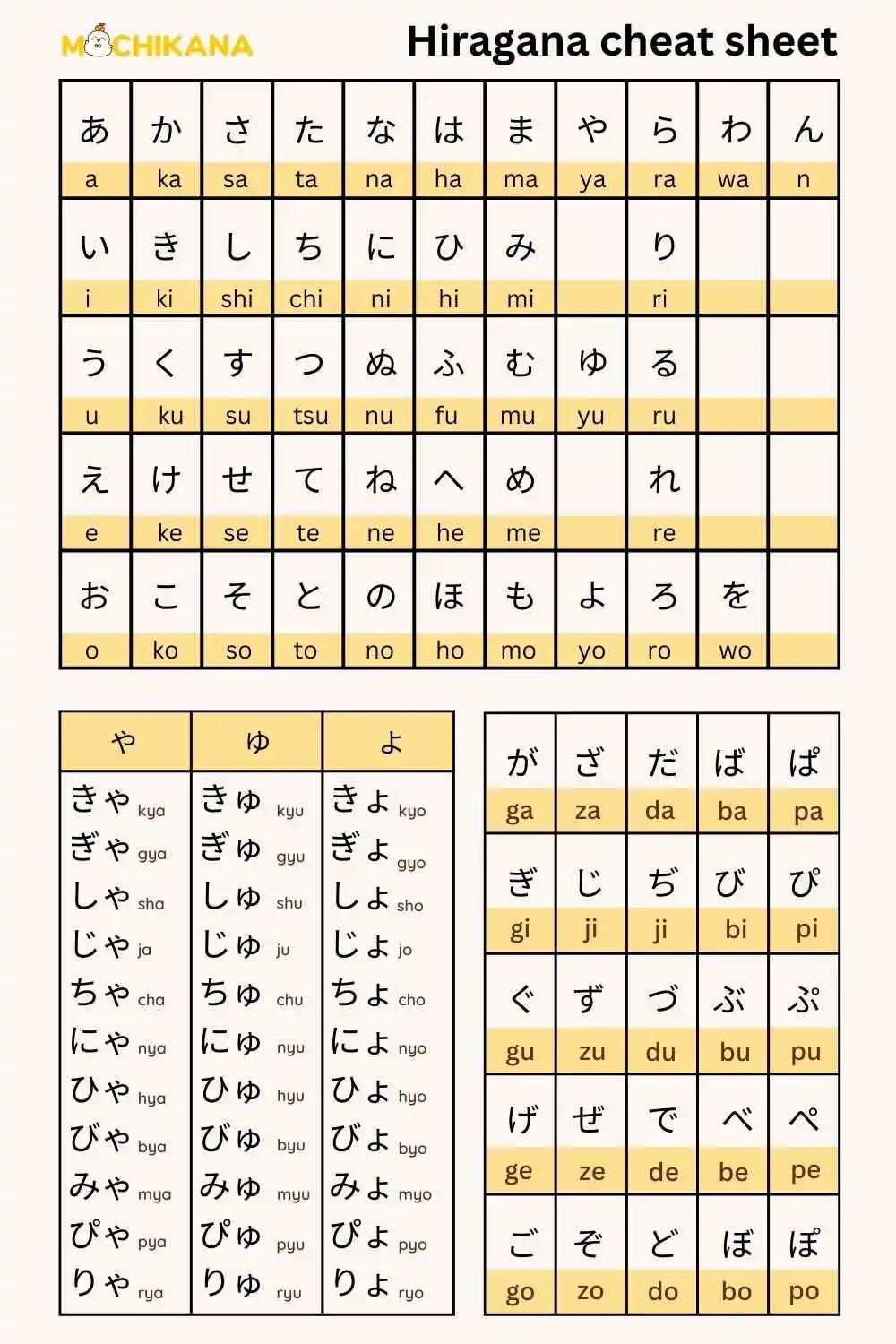
Hiragana chart

The 5 types of characters in Hiragana chart
Hiragana characters can be grouped into five functional types as the following:
- Basic Hiragana: the core 46 characters
- Daku-on: sounds with added marks such as が (ga), じ (ji), で (de)…
We created these by adding dakuten ゛to a Hiragana character. - Handaku-on: for example "p" sounds, like in ぱ (pa), ぴ (pi), ぷ (pu)…
This is when you add han-dakuten ゜to a Hiragana character in the H-column. - You-on: combined sounds, for example きゃ (kya), しゅ (shu), ちょ (cho)…
To create this, we write a small ゃ, ゅ, or ょ after a Hiragana from I-row. - Small tsu: used for pronunciation and timing, for instance けっか (kekka)
This "tsu" doesn't produce a sound on its own. Instead, it creates a brief pause that sharpens the following consonant. A helpful way to understand it is to think of it as marking a "double consonant," since that consonant is written twice in romaji.
Now that you've learned how these extended characters work, reading Hiragana will feel much more natural, and you'll be able to recognize words with greater confidence.
Learn Hiragana from the basics
If you’re asking yourself how to learn Hiragana, don’t worry—it’s simpler than it looks! Here's a step-by-step approach to get you started:
- Study a Hiragana Chart: A Hiragana chart is a great tool for beginners. It lists all the characters, helping you visualize each one. Keep it handy as you practice!
- Practice Reading: Start with simple sentences and read aloud. This will help you get comfortable with the sounds and how Hiragana flows in actual language use.
- Write It Out: Practice writing Hiragana by hand. The repetitive action helps with muscle memory, and you’ll get familiar with the shapes.
- Use a Hiragana Keyboard: Typing in Japanese? You'll need to install a Hiragana keyboard on your phone or computer. It’s an excellent way to practice recognizing and using Hiragana while you type.
- Flashcards & Apps: There are plenty of apps and online resources that offer Hiragana flashcards, quizzes, and games. These tools. make it fun to test your knowledge and track your progress. We recommend you trying MochiKana. MochiKana is an app that provides fun lessons of how to read and write Hiragana step by step.
So, what is the difference between Hiragana and Katakana?
This is one of the most common beginner questions. Let's take a look at our simple table below.
| Hiragana | Katakana |
|---|---|
| Used for native Japanese words | Used for foreign loanwords |
| Used for grammar & sentence structure | Used for names, brands, emphasis |
| Soft, rounded shapes | Sharp, straight strokes |
| Learned first by beginners | Learned after Hiragana |
FAQ
1. Is Hiragana still used in Japan?
Yes, of course. Hiragana is used every single day in modern Japan. You will see Hiragana in almost everything: books and newspapers, menus and signs, text messages and social media, everyday handwriting, … Even fluent Japanese texts always contain Hiragana because it is essential for grammar and readability.
2. Do Japanese prefer Hiragana or Katakana?
Japanese people don't "prefer" one over the other, they use each writing system for different purposes. While Hiragana feels natural, soft, and friendly; Katakana feels foreign, modern, or emphasized. For example, when writing children's books, Japanese people might use more Hiragana. And when writing a brand name or product name, they will probably use Katakana. As a learner, you should focus on Hiragana first, because it appears everywhere and forms the backbone of Japanese sentences.
Are you ready?
Hiragana is your gateway to mastering Japanese. Once you've learned it, you’ll be well on your way to understanding more complex aspects of the language. By using a Hiragana chart, practicing with a Hiragana keyboard, and incorporating fun learning tools, you’ll find that memorizing and learning Hiragana becomes much easier. Keep practicing every day, and soon enough, you'll have all those Japanese letters down!
Happy learning, and remember—every small step counts!